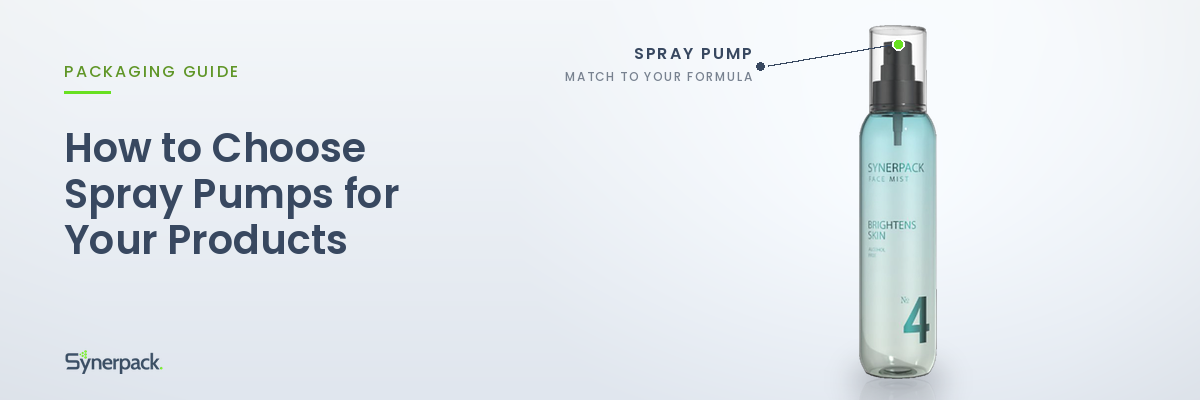
A spray pump is a small engine that decides how a product comes out, how much, how fine, and how reliably. It draws liquid up, builds pressure, and pushes it through a nozzle with every press. Choosing the right one is a technical decision that shapes how a product feels and performs.
The pump market reflects how central these parts have become. The dispenser pump market is projected to grow from $7.37 billion in 2025 to $12.68 billion by 2034, at a CAGR of 6.23%, according to Towards Packaging. That growth is driven by demand for precise, hygienic dispensing across cosmetics and personal care.
So how do you choose spray pumps that fit your product? This guide focuses on the pump itself, the output, the neck size, the actuator, and the formula match, so you can spec the right part for your line.
Understanding Spray Pump Output
Output is the first number to nail down. It is the amount of liquid a pump pushes out with each full press, and it shapes how the product is used.
Output is measured in milliliters per stroke, and the right figure depends on the product:
- Low output (around 0.1 to 0.15 ml): Creates a fine, light mist. Best for facial toners and mists.
- Medium output (around 0.15 to 0.30 ml): A balanced spray for body mists and hair products.
- Higher output (0.30 ml and up): Pushes more liquid per press, suited to larger-area sprays.
A lower output forces the liquid through more pressure, which creates a finer spray. A higher output releases more liquid in larger droplets. Matching output to the product is what separates a soft facial mist from a wet, heavy spray.
Matching Spray Pump Bottles by Neck Size
Here is a detail that trips up many first-time brands: the pump has to physically fit the bottle. That match is set by the neck size, the threaded opening at the top of the bottle, and it is what makes spray pump bottles work as a sealed unit.
Neck sizes are written as two numbers, like 18/410 or 24/410. The first number is the diameter in millimeters, and the second is the closure of thread style. Your pump and bottle must share the same neck finish, or they will not seal.
A few things to confirm on fit:
- Neck diameter: Common cosmetic sizes are 18 mm, 20 mm, and 24 mm. The pump must match the bottle.
- Thread style: The closure code (like 410 or 415) sets out how the threads engage. Mismatched threads leak.
- Dip tube length: The tube should reach the bottom of the bottle, cut to the right length, so the pump empties it fully.
Getting the neck and dip tube right is what makes a pump spray bottle work as a reliable unit. It is worth confirming with samples before a full run.
Actuator Types for Cosmetic Spray Pumps
The actuator is the button you press. It controls how the spray is triggered and whether the pump stays locked during shipping, and the right one depends on how customers will use the product. Cosmetic spray pumps come with a few common actuator styles:
- Lock-down actuators: Twist to lock the pump closed, which prevents leaks in transit and in a bag. Good for travel and shipping.
- Free-flow actuators: Spray with a simple press, no lock. Simple and fast for at-home products.
- Smooth vs ribbed closures: A styling choice that also affects grip. Smooth looks cleaner; ribbing is easier to twist.
For a hand pump spray bottle that travels, a lock-down actuator is usually the safer pick. For a product that lives on a bathroom shelf, a free-flow actuator keeps things simple.
Matching Fine Mist Spray Pumps to Your Formula
This is where pumps succeed or fail in practice. A pump that works with water can struggle with a thick or oily formula, so the pump has to match the viscosity of what is inside.
Thin liquids like toners flow easily, so they pair with fine mist spray pumps and small output. Thicker formulas need a pump built for higher viscosity, or they will sputter and clog. Oil-based products can also need a pump with a compatible gasket, since some materials swell or degrade with oils.
So, before you commit, match these to your formula:
- Viscosity: Thin formulas suit mist pumps; thicker ones need a stronger pump and wider output.
- Gasket material: Confirm the seal is compatible with oils, alcohols, or active ingredients in your formula.
- Spray pattern: Test that the spray is even and the right shape for the product.
The right match keeps a bottle pump sprayer working smoothly from the first press to the last, with no clogs or weak sprays.
Comparing Spray Pumps for Cosmetics
To pull it together, here is how the main pump types compare output, formula, and use.
| Pump type | Typical output | Best formula | Common use |
| Fine mist pump | 0.1 to 0.15 ml | Thin, water-based | Toners, facial mists |
| Body or hair mist pump | 0.15 to 0.30 ml | Thin to medium | Body mists, hair sprays |
| Treatment pump | 0.1 to 0.2 ml | Medium, serums | Serums, precise dosing |
| Lotion or cream pump | 0.5 ml and up | Thick, viscous | Lotions, creams, washes |
The takeaway is simple. Match the pump output and strength to your formula and how it is used. The right spray pumps make a product easy and pleasant to use, while the wrong ones lead to clogs, leaks, or uneven spray.
Sourcing Custom Spray Pumps Wholesale
Once you know the spec, a few checks protect your order. Sourcing is about matching parts precisely, so testing matters more than with simpler packaging. Here is what to confirm with a supplier when ordering custom spray pumps:
- Neck-finish match: Send your bottle spec so the pump fits the exact neck size and thread.
- Output testing: Confirm the ml-per-stroke output matches what you ordered, on samples.
- Formula testing: Run your actual product through the pump to check for clogs or seal issues.
- MOQs: Check minimum order quantity. New brands want low or flexible minimums.
Always test pumps with your real formula and bottle before a full run. Buying custom spray pumps wholesale also lowers your cost per unit as you scale. Synerpack helps skincare brands spec, test, and source the right pump and bottle pairing from first idea to final delivery.
Conclusion
Choosing spray pumps comes down to four things: the output, the neck size, the actuator, and the formula match. Get that right, and the pump dispenses cleanly and reliably every time.
Start with your formula and how customers will use the product, then specify the output and fit to match. Test samples with your real product before you commit. Done well, the pump becomes the part of your packaging customers never have to think about, because it just works.
Ready to specify the right spray pump for your product?
Synerpack helps skincare brands choose, test, and source spray pumps, from fine mist and treatment pumps to lotion and lock-down designs, matched to your formula and bottle. Whether you are launching your first product or scaling a range, the team can find the right fit for your formula and budget.
Frequently Asked Questions – FAQs
Q.1 What is a spray pump?
A spray pump is a dispensing part that draws liquid up from a bottle and pushes it out as a spray or mist. It uses a small pressure chamber and a nozzle to control how much product comes out and how fine the spray is.
Q.2 How do spray pumps work?
Spray pumps work by building pressure in a small chamber when you press the actuator. The pressure forces liquid up a dip tube and through a nozzle, which breaks it into a spray. Output and nozzle size control how fine the result is.
Q.3 What is the spray pump output?
Spray pump output is the amount of liquid a pump dispenses per press, measured in milliliters per stroke. Lower output, around 0.1 ml, creates a fine mist, while higher output releases more liquid in larger drops.
Q.4 How do I match a spray pump to my bottle?
Match the pump to the bottle by neck size, written as a code like 18/410. The diameter and thread style must match, and the dip tube must reach the bottom of the bottle. Confirming this with samples prevents leaks.
Q.5 Where can brands buy spray pumps wholesale?
Most cosmetic packaging suppliers sell spray pumps wholesale, in different outputs, neck sizes, and actuator styles. Buying spray pumps wholesale lowers the cost per unit, and a good supplier helps match the pump to your bottle and formula.